Category: health

  • Passing Through

    Passing Through

    A man went to visit a monk in the forest. After some time searching he found a small hut with smoke rising from a chimney. It was the monk’s hut. The man stopped at the entrance, knocked, and entered. Once inside he was surprised to see a single room, bare but for a table and two chairs. The monk was sitting in one of the chairs. The monk motioned the man to take a seat in the other chair.

    “How can I help?” asked the monk.

    Distracted by the sparseness of the room, the man asked, “Where are your things?”

    “Where are yours?” asked the monk.

    “But I am just passing through,” said the man.

    “So am I,” said the monk.

    Nearing retirement, but not quite there, I notice that the field of therapy is changing. The pandemic caused a shift to online work. Third-party companies manage a lot of the demand for therapy. I have adapted to the online work. But I have let go of many of the third-party contracts that used to flood my office with clients. No more flood.

    “The most flexible practice wins,” according to my business coach1. I owned that on the first of this year: I gave up my office. Now I rent it back by the day when I need it. The rest of the time I work from home.

    I’m back in the office today. Same office, but more like the monk’s hut now. Sparsely furnished. I am just passing through.

    On the drive in this morning I had uncomfortable feelings. I recalled the work of Les Greenberg – he was Sue Johnson’s supervisor, of EFT fame. Les taught me that emotion is a primitive sensory system. It’s supposed to tell you when things are out of whack.

    My emotions are telling me that things are out of whack. That does not necessarily mean that I should put things back into whack. I could. Or I could revel in the change.

    I have more time now to reflect on the meaning of life, which has been a lifelong passion of mine. It is the reason I studied physiology, to get an idea of what life means biochemically, and then theology, to get an idea of what life means metaphysically.

    Some years ago I met Karl Tomm, a Calgary psychiatrist recently named to the Order of Canada. When I told him about my quest for the meaning of life, he told me to read Humberto Maturana’s The Tree of Knowledge. Maturana is back on my desk (at home).

    Maturana takes a process approach to biology. He has much in common with the theologian, Paul Tillich. When a biologist and a theologian agree, it’s a special day.

    Both talk about life as arising from a buildup of complex molecules. Hydrogen is the simplest element – the simplest atom. Life as we know it requires molecules made of carbon – much more complex. How does the carbon get formed?

    The answer is in the stars. Stars are made of hydrogen. The hydrogen collects and forms a big ball, which becomes massive, and when its density reaches a critical stage, fusion begins. The hydrogen atoms combine to form heavier elements. Tremendous amounts of energy are released. This process lasts about six billion years, from birth, the beginning of fusion, to death, when its hydrogen runs out and has been converted to heavier elements – including carbon. At this point the dying star explodes – goes nova, which interestingly means “new” – and the heavier elements are spewed across the universe.

    Our earth was formed from these heavier elements.

    Our sun is only 4.5 billion years old. We have time. But we, like everything else, are just passing through. In the process, we gain complexity. And then we let it go again. Power separates us from the surrounding environment. And when we die and reconnect with our environment – Tillich calls this “love”.

    As these molecular remnants of dying stars coalesce and cool, they combine and become more complex. Carbon-based molecules can be quite complex, forming proteins and enzymes and eventually “networks of molecular reactions (which) produce the same types of molecules that they embody, while at the same time they set the boundaries of the space in which they are formed.” 2

    This is the definition of life. Not the one you learned in high school, but a process definition of life. Life is that which reproduces itself, and sets boundaries between itself and its environment. Tillich, the theologian, calls the setting of boundaries power. Life thus involves the ability to create, the ability to differentiate, and the power to do both.

    I was trying to get to my uncomfortable feelings. One of the consequences of life – a reproducible entity with power – is that living beings are constantly interacting with the environment beyond their boundaries, monitoring it for changes which could threaten their existence.

    In order to do this every living thing develops a reflex, so that whenever a change is sensed in the environment, the living thing reacts to minimize the effect of the change on its internal processes.

    If I live long enough I will say more on this.

    There’s more to this that I haven’t teased out yet, but this has bearing on what is happening to our world. Not just to my office.

    1. Lynn Grodzki, Building Your Ideal Private Practice
    2. The Tree of Knowledge, p. 37
  • The Name of the Game

    The Name of the Game

    So I play this game.

    When I was younger and more serious I would have told you that it wasn’t a game. It was a flight simulator. And that’s what it is. A fairly serious flight simulator.

    But really it’s a game.

    I’m a big fan of playing games.

    Years ago I went to the local airport and got someone to take me up in a small plane. Then I kept going back, and paying for lessons. I could only afford to fly once a month. But over the months I gradually gained experience…

    I had a flight simulator on my first computer, a Commodore 64. I would “fly” on my computer between flying lessons. It was not very sophisticated. But it did help me to practice.

    I kept going back to the airport. Eventually they let me solo. Then I got my private license. Then I passed my flight exam with my wife so I could take our kids up.

    And then I got my night rating, and my commercial license, and my multi-engine rating. And I kept playing my game between lessons.

    I never worked as a pilot. I did spend a lot of money on flying. I regret nothing.

    I flew real airplanes for nearly 3 decades. But eventually I had to stop. I am back to where I started. Just the game. And a lot of memories…

    Games are important. They allow us to pretend to be someone and to do something that we maybe can’t do in real life. They expand our horizons.

    Also they prepare us for real life. When you use your imagination and pretend to do something, the same parts of your brain are activated as if you really did that thing.

    Now I’m not saying that you can play a game and then fly a plane. There was some translation involved. Also many hours with instructors.

    But I had a client who was a basketball player and who broke her leg. After her leg healed she was afraid to go back on the court.

    So I played a game with her. I put her into trance. And I had her imagine that she was on a basketball court, playing a game of basketball, with spectators on the benches making noise and the feel of players bustling up and down the court, and the feel of the ball and the smell of the hall…

    And within a short time, she was playing the real game again.

    Games are not just games.

  • Being

    I am beginning to enjoy

    My boring life

    Having discovered

    That the brain levels up

    With boredom

    And letting go

    Of the need to Do Things

    Just being in the world

    Being me

    With all my foibles

    And frailties

    And letting go of fear

    Embracing life

    As it is

    Here and now

    I become

    My true self

    And the gift to the world

    I was meant to be.

  • A Butterfly that Knows Itself Can Change the World

    I hesitated to write this column because, I said to myself, I am worrying about what I can’t control, and I tell my clients all the time not to do this – not to worry about what you can’t change.

    I am worried about the United States. Recall that my ancestors came from there. I still have family in the U.S. I also have friends: two of my closest from high school.

    I have membership in a number of U.S. organizations: for hypnosis, for marriage and family therapy, and for contextual behavioural therapy (without the “u”).

    There are a lot of good people in the United States.

    I was born 14 years after the end of World War II, and grew up in the Cold War era. Not only did I live in fear of a nuclear attack but I actually thought I was witnessing one on November 10, 1979, when a Canadian Pacific train carrying propane derailed and blew up in Toronto.

    I have never experienced war. I read about the Nazis and the holocaust. I suppose we have our share of guilt over our treatment of First Nations people. But I have, for the most part, lived a peaceful, protected life, where not a lot of bad stuff was happening at my front door.

    That’s changing now. I don’t like it.

    The United States is being transformed. It is not a pleasant transformation. Not a “good” transformation. It seems to be a big step backward.

    As a healer, I lean in the direction of wanting to help people. As a systemic therapist, I recognize that we participate in a complex system of interaction with each other, with other living systems, and, of course, with the environment.

    I have been trained to see the value in all parts. We need each other.

    Not everyone shares that view.

    I do not understand U.S. government. I tend to simplify and draw analogies with Canada. The Republican Party seems to be a conservative version of our Conservative Party. Very right: individual liberty, traditional values, limited government.

    The Democratic Party leans to the left: equality, social justice, and government intervention. Democrats are perhaps more to the right than our Liberals, but definitely left of the Republicans.

    I have read1 and I understand that we need each other. Conservatives (Republicans) remind us to value individual freedom, tradition, and to combat government overreach. Liberals (Democrats) remind us that we have a responsibility to help those less privileged.

    The tension between these two views seemed to work for years. Left and right balanced each other. But maybe I just wasn’t paying attention.

    And of course these parties weren’t operating in isolation. I have written recently on the constantly changing environment, and the need to adapt to it. The world is changing all the time.

    As the world becomes less hospitable – more heat, more storms, fewer places of safety, melting ice caps (less land) – anxiety is increasing.

    It’s great for business.

    There are more people (also great for business). As of two weeks ago, the world population passed 8.2 billion2. The number of people on the planet is increasing at a rate of nearly 10 per second.

    With more people, less land, and a climate that seems to be trying to kill us, not everyone is going to therapy to talk about it. Some people are trying to solve these problems. Some are confronting the complexity and seeking rational, scientific solutions.

    Others are not so much into science.

    I’m old enough to remember Ronald Reagan, who served as the 40th American President from 1981 to 1989. I remember how funny we all thought it was that an actor became president of the United States. He was popular because he was a change, a Republican correction at a time when people were disillusioned with the Democrats.

    He had his own problems and caused his own scandals.

    The pendulum swings back and forth, but I’m afraid that it’s going to stop swinging now. PBS reported that Trump was behind the Jan 6 insurrection (and now he has defunded PBS). This new reality TV star president famously said, “You won’t have to vote again”. He seems to be following through by systematically undermining the normal checks and balances that keep the President from becoming a dictator.

    Trump offers an alternative to grappling seriously with the world’s problems: ignore them. Get rid of all the immigrants. Get rid of all the scientists. Get rid of all the teachers. Just don’t think about the problems of the world. Stop trading with them, even. Close the borders. Shut your eyes. Everything will be fine.

    Trump is gaining in popularity and power in the same way that Hitler did, for similar reasons, perhaps. When times are tough it is tempting to put your head in the sand.

    I thought this was all going to stay in my history books, not come back to bite me. I thought I was born after World War II…

    But I am a family therapist, and this gives me hope. Because I believe in butterflies.

    Family therapy is a little different from what you might think of when you think of psychotherapy. You may think about one person lying on the couch and talking about their mother. That’s psychoanalysis. It’s helped a lot of people. It’s not bad.

    Family therapy started from a different premise. Instead of seeing the problem as residing in one person (or coming from your mother), family therapy defines the “problem” as an interaction. No one individual to blame. The whole system holds the problem. An alcoholic for example is part of an alcoholic family system: one person drinks, another pays the bills, another goes to school and pretends everything is fine at home. Everyone plays their part.

    This mess of a world – not just the U.S. but all of us – is just one big alcoholic family system.

    In a system, true, some parts are more powerful than others, but every part influences it, to some degree.

    Even the butterflies. Even me.

    My systemic lens suggests to me that Trump is gaining popularity because of climate change. The world is becoming inhospitable. Left-leaning governments and individuals are rising to the challenge and struggling to find ways to slow the rate of climate change, and help those affected by it.

    Right-leaning governments and individuals are narrowing their view of tribe. Building walls to protect their limited resources and to keep others away. Leaning in to individual freedom. Leaning away from helping others.

    Left or right, individuals matter. Speaking your own truth matters. Differentiation matters.

    If you pay close attention you will see that not everyone is singing the same tune. There are dissonant voices. You can hear them.

    Want to help change the world for the better? Speak your truth. Wherever you are, in whatever context, speak your truth. Monitor your diet of social media. Take breaks. Look for evidence. Take the harder road. Challenge your own beliefs.

    Differentiation matters. A human being begins as a single, fertilized egg. It does not remain so. As it divides, the new cells differentiate. Each assumes a unique function. Nerve, bone, blood, muscle, fat. Everything is useful, and everything is needed to make a human being.

    Everyone is needed to make a human species.

    All you really have to do is be different than the troublemakers. Speak your truth. Just that. Speak to what you see. Like the child who saw that the emperor had no clothes, add your tiny voice to the mix. Your voice that is dissonant. It refuses to buy into or believe lies. That’s all you need to do.

    Systems are powerful but they are not omnipotent. A small, dissonant voice can wear a mountain of lies away like a persistent drop of water.

    Just so. Speak the truth.

    Even large systems have to adjust to the dissenter, over time. They can’t help it. They have to follow the same rules that enabled them to form their dominant story: everyone has a part; everyone has a voice. Anyone who dissents also has a voice. And this changes the whole, over time.

    So perhaps I am worrying about what I can control. And perhaps I am doing what I need to do. By simply speaking.

    1. Jonathan Haidt (2012). The Righteous Mind: Why Good People are Divided by Politics and Religion. New York: Pantheon Books ↩︎
    2. https://www.worldometers.info/world-population/ this is a really cool web page. You can watch world birth and death rates in real time. Ten people are added to the world every second. One person dies every second. Net growth, 9 people per second. ↩︎

  • How to Save the World

    Maturana and Varela, Chilean biologists, wrote an essential book called The Tree of Knowledge. They “explain” evolution according to a simple rule that even a single-celled organism can follow:

    Don’t piss off the environment.

    We talk about climate change like it is something we caused and can therefore reverse. That may be partly true. What is more true is that the climate – the environment in which we live – has been changing for millions of years. Since the earth was formed.

    The world is always changing. We can’t stop that. We can’t change it back. We can only change with it.

    For the single-celled organism to survive, it has to change as its environment changes. If it doesn’t, it dies.

    If the environment changes in such a way that the cell is perturbed – disturbed from its resting state, its homeostasis – then the cell has a simple reflex. Using what it has internally, it changes itself to adjust to the environmental change. And then it can rest again.

    As it changes to meet the environmental challenge, the cell acquires new skills. New organelles. New capabilities.

    The cell benefits from change. It survives.

    Cells that don’t change eventually die out. The environment continues to change, and after awhile the difference between what the cell needs and what the environment has to offer is too great, and the cell simply cannot survive.

    The cell also benefits because it acquires new skills. New abilities. If the temperature increases, it learns how to adjust its internal temperature accordingly, so that its chemical reactions continue in an optimal way. And by promoting this change, the cell develops strengths that it didn’t have before. And it is better equipped to meet the next challenge.

    Athletes know this. Students know this. Parents know this. Meet the daily challenge. Change with it. Learn something new. Become a little stronger. You are better prepared to meet the next challenge.

    There are millions of single cells out there still adjusting to the environment, one day at a time. But this has been going on for so long that some of the first cells who adapted to change have themselves changed so much and become so equipped that they can do what to a single cell would be unthinkable, if it could think.

    At some point cells started clumping together for mutual support. Groups of cells began to specialize, supporting other groups of cells with what they produced, and taking from them what they no longer made for themselves. A sort of free market of cell communities.

    These groups of cells became recognizable as living things. Plants, animals.

    Some of these animals became self-aware. Psychological1.

    Some of these self-aware animals became other-aware. Spiritual2. Recognizing that they exist in a world that places limits and makes demands. Recognizing that continued survival of the whole – all living things – requires a form of global cooperation.

    The next stage of our evolution remains to be seen. But the process is clear: when the environment challenges, you must respond. Use everything you have to meet the challenge. Adapt to it, become stronger, and be ready for the next challenge.

    We have acquired an impressive collection of wisdom and knowledge and history. Like a cell with well-developed organelles, we have powerful tools to meet the present environmental challenges, if we value and use everything we have.

    Roughly half of us don’t want to do this anymore. Don’t want to change. Change is hard. But not to change is like so much of mental illness in general and addiction in particular: a short-term gain for a long-term disaster.

    Adapting to a changing world means upgrading ourselves. Upgrades are hard. Not all the bugs have been worked out. There are glitches in this newest human operating system which has been handed down to us. That however is not a call to go back to Windows 1.0. Not a good survival strategy.

    If we want to save the world – save ourselves in the world, really. The world doesn’t care – all we have to do is embrace change. Acknowledge that the environment is becoming uncomfortable. Work together as a single organism, using what we have, to change so that we adjust. To the new world. In a way that uses everything – and everyone – that we have.

    1. Paul Tillich (1976), Systematic Theology 3. University of Chicago Press. ↩︎
    2. Ibid. ↩︎
  • Fear and Flying

    Fear and Flying

    I think I suffer from a form of OCD. You know what OCD is, don’t you? It’s an anxiety disorder where you seek to relieve your anxiety by performing a compulsive task.

    I worry about becoming irrelevant.

    So to deal with that anxiety, I learned to fly. Surely pilots are relevant.

    I became a pilot in 1991. I flew a small plane until about ten years ago. I gained in skill and I eventually got my commercial licence, but you need a lot of flying time to be hired as a pilot, and you have to be willing to travel. I had this family who needed me home. And I wanted to be home with them, too.

    So I stopped flying.

    And now I am older. I still fly. On my computer.

    So whenever I am worried about becoming irrelevant, I play a game on my computer now.

    That’s not as relevant as it used to be.

    I have a friend about my age who used to be a pilot. He flew for Air Canada. He stopped flying too. Now he does computer programming. He plays games on his computer, only people buy his games.

    So that’s relevant.

    I am more of a storyteller. And a listener. And while a part of me had always wanted to learn to fly – I was pretending to be a pilot when I was four. I crashed and broke a tooth – a bigger part of me has always wanted to be a helper and a healer.

    So now I help and I heal. Through listening. And storytelling. That, essentially, is what a psychotherapist is.

    And I still fly, on my computer.

  • Tariff Day

    Today is Tariff Day. But it’s also Chocolate Cake Day.

    Tariffs are bound to interrupt your digestion. Money generates anxiety at the best to times. Having to pay more money for things – well, that will generate anxiety. Anxiety, that signal of impending emergency. Evolution has long favoured interrupting meals in case of emergency.

    According to the polyvagal theory1 we humans have three ways of dealing with emergencies.

    The earliest and simplest is to freeze. Recall Jurassic Park. Don’t move. He can’t see you if you don’t move.

    It actually works, even on threats who can sense non-moving things, because non-moving things just don’t register as easily on a predator’s brain. Who wants a dead lunch? Might not be fresh.

    So our most ancient response to threat is to freeze, slow down the respiration rate, slow down the heart rate, and stop digestion (lest you fart and give yourself away). Play dead.

    That might work. Make no response to tariffs. Perhaps they will go away and try to eat somebody else.

    But if not, we have more evolved defence systems in our toolbox. The sympathetic nervous system (SNS) and the hypothalamic-pituitary-adrenal (HPA) axis are activated in the face of a threat that might not be fooled by our freezing: we can run away, or fight. This requires energy. So now the heart rate ramps up – feel your chest pounding? – hearing and seeing are sharpened, and blood flow increases to the arms and legs (for running or fighting).

    Again, lunch is postponed. Digestion shuts down. No time to eat when you’re about to be eaten. Run away now.

    But how long can you run? And is running away, by yourself, the best option?

    You can burn rubber in an emergency, but there should be alternatives. Can’t run or fight forever. Evolution has tended to favour energy conservation.

    The vagus nerve is quite complex. It helps us freeze. It helps us fight, or flee. And it helps us call for help. Sends messages to the heart to slow it down. Sends messages to the lungs to open them up. Sends messages to the face and head. So you can call to others. For help.

    Safety in numbers.

    America is being conned. Its people are being told that they are stronger alone. They aren’t.

    It’s a small world. We need each other. Hopefully this tariff nonsense will pass away soon, and we can get on to the chocolate cake.

    1. Stephen W. Porges (2011). The Polyvagal Theory: Neurophysiological Foundations of Emotions Attachment Communication Self-Regulation. New York: W.W. Norton ↩︎
  • No Pain, No Gain

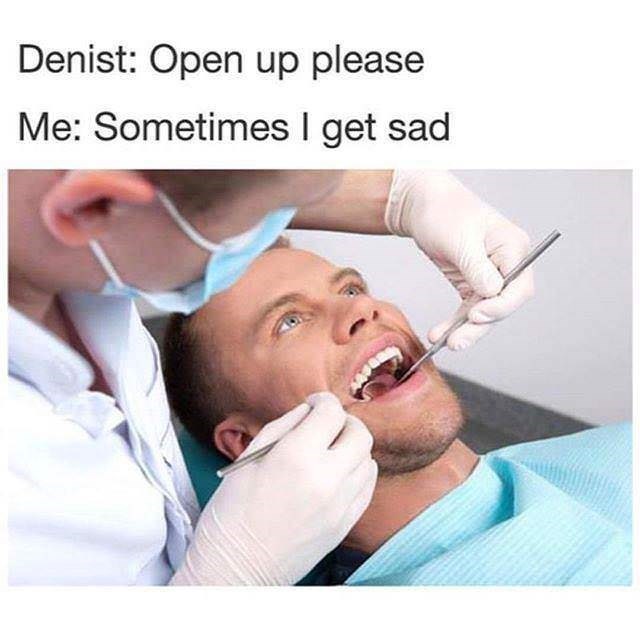
    Did you notice the typo above? It was a convenient image. But the problem with convenience is that I can’t edit it…

    I was sitting in the dentist’s chair this morning, having made an appointment to explore the cause of my tooth pain. Of course, to diagnose the pain you have to experience it. So the dentist says to his assistant, “Get the cold probe ready, please.”

    And I groan.

    And he leans over and says to me, “Ah, I see you know the drill.”

    Sometime later I got the reference to “drill” and I laughed.

    “That took you twenty minutes, Carl,” my coworker said. “You’re slow this morning.”

    And so I am. Slow, and pondering my age and things breaking down.

    On the way to work I pass a sign that says, “Only through Jesus will you have eternal life.” I happen to be a clergyman. But I look at that sign each morning and I think, “That’s not true. Everyone has eternal – something.” I don’t know whether you call it life, but all the parts of me, no matter how many have served their useful function and may have to be removed before the rest of me becomes the smoking hot body I’ve always wanted – the sum total of what makes me me, will persist in some form after the body that is me stops whining and breathing.

    The elements of which I am comprised aren’t going anywhere. Ashes to ashes, dust to dust. Paul Tillich1 has a lot to say about dust, the stuff of which we are made. Atoms, molecules, energy – neither created nor destroyed. I will persist in some state.

    Even that tooth that has to come out next week will persist, apart from me. Not the first part of me that I have had to part with. Another part of me is departing for parts unknown. But it will persist. I will persist.

    I just hope I don’t spread myself too thin.

    I’m playing with a concept called “acceptance”, made popular by Steve Hayes’s Acceptance and Commitment Therapy, or ACT2. According to Hayes, health requires psychological flexibility. And psychological flexibility requires acceptance.

    Acceptance is, according to Hayes as reported by Dave Moran3, “Actively contacting psychological experiences directly, fully, and without needless defence while behaving effectively.”

    So I am trying to let go of this tooth more graciously than the last. This isn’t my first extraction and likely won’t be my last.

    I grieved the last tooth and I will grieve this one. But healthy grief requires full contact with the experience. And that’s painful. And that’s okay. It makes life meaningful. It improves your psychological flexibility.

    I found this same point echoed in a different context in Oliver Burkeman’s Four Thousand Weeks. He argues against convenience:

    Convenience…makes things easy, but without regard to whether easiness is truly what’s most valuable in any given context…When you render the process more convenient, you drain it of its meaning.4

    I don’t want to be a doomsayer about social media – I too use TikTok while it’s still legal – but one of the downsides of social media is its convenience. You can get a dopamine hit from each bit of information without having to work for it (also without knowing whether it is reliable). Too much of this makes me feel sort of thin and stretched in the way I hope not to end up.

    Then I pick up a book.

    Life is short. Life is hard. That’s okay. Engage every moment of it fully. Enjoy it.

    If you see my tooth, say hello.

    1. Tillich P (1963), Systematic Theology Volume Three Chicago: University of Chicago Press
    2. Hayes SC et al (2011). Acceptance and Commitment Therapy: The Process and Practice of Mindful Change. New York: Guilford Press
    3. Dr. Moran gives an entertaining introduction to ACT therapy in a PESI lecture, catalog.pesi.com
    4. Burkeman, Oliver. Four Thousand Weeks: The smash-hit bestseller that will change your life (pp. 52-53). Penguin Canada. Kindle Edition.