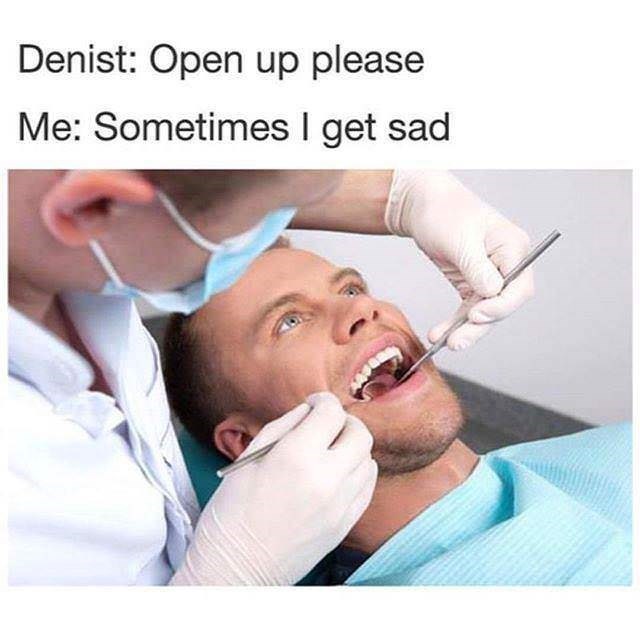
Did you notice the typo above? It was a convenient image. But the problem with convenience is that I can’t edit it…
I was sitting in the dentist’s chair this morning, having made an appointment to explore the cause of my tooth pain. Of course, to diagnose the pain you have to experience it. So the dentist says to his assistant, “Get the cold probe ready, please.”
And I groan.
And he leans over and says to me, “Ah, I see you know the drill.”
Sometime later I got the reference to “drill” and I laughed.
“That took you twenty minutes, Carl,” my coworker said. “You’re slow this morning.”
And so I am. Slow, and pondering my age and things breaking down.
On the way to work I pass a sign that says, “Only through Jesus will you have eternal life.” I happen to be a clergyman. But I look at that sign each morning and I think, “That’s not true. Everyone has eternal – something.” I don’t know whether you call it life, but all the parts of me, no matter how many have served their useful function and may have to be removed before the rest of me becomes the smoking hot body I’ve always wanted – the sum total of what makes me me, will persist in some form after the body that is me stops whining and breathing.
The elements of which I am comprised aren’t going anywhere. Ashes to ashes, dust to dust. Paul Tillich1 has a lot to say about dust, the stuff of which we are made. Atoms, molecules, energy – neither created nor destroyed. I will persist in some state.
Even that tooth that has to come out next week will persist, apart from me. Not the first part of me that I have had to part with. Another part of me is departing for parts unknown. But it will persist. I will persist.
I just hope I don’t spread myself too thin.
I’m playing with a concept called “acceptance”, made popular by Steve Hayes’s Acceptance and Commitment Therapy, or ACT2. According to Hayes, health requires psychological flexibility. And psychological flexibility requires acceptance.
Acceptance is, according to Hayes as reported by Dave Moran3, “Actively contacting psychological experiences directly, fully, and without needless defence while behaving effectively.”
So I am trying to let go of this tooth more graciously than the last. This isn’t my first extraction and likely won’t be my last.
I grieved the last tooth and I will grieve this one. But healthy grief requires full contact with the experience. And that’s painful. And that’s okay. It makes life meaningful. It improves your psychological flexibility.
I found this same point echoed in a different context in Oliver Burkeman’s Four Thousand Weeks. He argues against convenience:
Convenience…makes things easy, but without regard to whether easiness is truly what’s most valuable in any given context…When you render the process more convenient, you drain it of its meaning.4
I don’t want to be a doomsayer about social media – I too use TikTok while it’s still legal – but one of the downsides of social media is its convenience. You can get a dopamine hit from each bit of information without having to work for it (also without knowing whether it is reliable). Too much of this makes me feel sort of thin and stretched in the way I hope not to end up.
Then I pick up a book.
Life is short. Life is hard. That’s okay. Engage every moment of it fully. Enjoy it.
If you see my tooth, say hello.
- Tillich P (1963), Systematic Theology Volume Three Chicago: University of Chicago Press ↩
- Hayes SC et al (2011). Acceptance and Commitment Therapy: The Process and Practice of Mindful Change. New York: Guilford Press ↩
- Dr. Moran gives an entertaining introduction to ACT therapy in a PESI lecture, catalog.pesi.com ↩
- Burkeman, Oliver. Four Thousand Weeks: The smash-hit bestseller that will change your life (pp. 52-53). Penguin Canada. Kindle Edition. ↩